
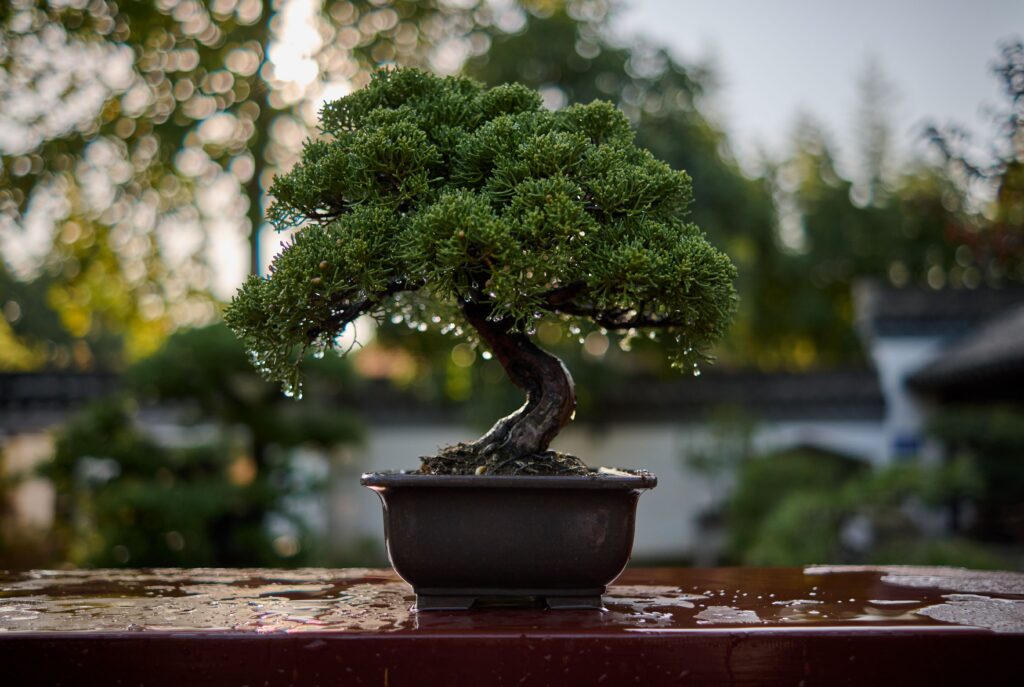
What Is Bonsai? A Beginner’s Guide to Understanding Bonsai Trees

Key Takeaway: Bonsai (盆栽, pronounced BONE-sigh) is the practice of growing an ordinary woody tree or shrub in a shallow container and shaping it, over years, to look like a full-size tree in nature. A bonsai is not a dwarf species and not a genetically miniaturized plant. It is a normal tree kept small on purpose — by root pruning, branch pruning, and container confinement — and kept alive indefinitely by ongoing care. The word means “planted in a shallow container,” and it refers to both the tree and the art of growing it.
If you’re here, you’ve probably run into the same confusion everybody runs into: What is bonsai , exactly? Is it a special kind of tree? Why does anyone do this? And how does it stay that small without dying?
I’ll answer all of it, plainly, in the next few minutes. I also came up with a four-part test you can use to tell a real bonsai from a $29 mall-kiosk plant with wire twisted around it.
What ‘Bonsai’ Means and Where It Came From
Bonsai is a Japanese word written with two characters:
- 盆 (bon): a shallow tray or basin
- 栽 (sai): a planting, or something planted
Put together: a planting in a shallow container. That’s the whole literal translation. No mystique, no mysticism.
The art itself is older than the Japanese word for it. It grew out of the Chinese practice of penjing (盆景, “tray scenery”), which was well established by the Tang dynasty and traveled to Japan with returning envoys and Buddhist monks. Japanese growers narrowed the focus from miniature landscapes with rocks and water to the refined portrait of a single tree. And that narrowed version is what the world now calls bonsai.
One interesting note: The American pronunciation of bonsai sounds VERY similar to banzai. Banzai (万歳) is a cheer meaning “ten thousand years.” Bonsai is a potted tree. The mispronunciation is common enough that people get confused but they are two completely different things.
What a Bonsai Tree Is — And What It Isn’t
A bonsai tree is a living tree, trained to stay small while looking old and weathered. The goal isn’t smallness for its own sake. It’s proportion, movement, and character — a convincing portrait of a mature tree, at a scale you can put on a bench.
Four things it is not, and each one trips up newcomers:
- It isn’t a species. There’s no bonsai tree in the botanical sense, and no such thing as bonsai seed. Those “bonsai seed kits” are ordinary tree seeds, usually of species that will take you a decade to develop into anything.
- It isn’t a genetic dwarf. A bonsai pine tree carries the same genes as a 60-foot pine tree . Nothing has been bred, engineered, or stunted at the DNA level.
- It isn’t self-maintaining. Stop pruning and a bonsai reverts. Within a couple of seasons it’s a scraggly pot-bound shrub. The small size is intentional and guided by consistent maintenance.
- It isn’t décor. It’s a tree that responds to light, water, seasons, and your mistakes. It needs attention (though far less obsession than people assume).
Getting that straight early saves a lot of frustration, and it filters out anyone hoping for instant results.
The 4 C’s: Is It Actually a Bonsai?
Here’s the test we use at BonsaiTrader when we’re evaluating a tree — a listing, a nursery find, something a friend was gifted. A bonsai satisfies four conditions. Miss one, and you have something else.
1. Candidate: it’s a woody perennial that can be reduced. The starting material needs a woody stem, true branches, and tolerance for root confinement. Juniper, pine, Chinese elm, ficus, Japanese maple, azalea, boxwood, jade — all fair game. Small natural leaf size helps, because foliage is the hardest thing to scale down convincingly.
Some trees just aren’t good candidates. For example, when my daughter, Magnolia, was born, I tried to bonsai a magnolia tree. When I moved it into a small pot the plant seriously struggled with the root confinement and the extra large leaves wouldn’t allow for scale.
2. Container: the roots are deliberately confined. The shallow pot isn’t decoration; root confinement is one of the levers that keeps the tree small, and the pot is chosen to complete the composition. A good trunk sitting in a nursery can of potting soil isn’t a bonsai yet. It’s pre-bonsai: raw material.
3. Composition: it’s been deliberately styled toward a natural form. This is the condition gift-shop plants fail. A bonsai is designed: someone chose a front, a trunk line, a branch structure, a silhouette that references a real tree shaped by decades of weather. A braided money tree with a bow on it has been arranged, not styled.
4. Continuity: it’s in ongoing cultivation, and it’s never finished. Growth continues, so pruning, wiring, feeding, and repotting continue. A bonsai abandoned for three years isn’t a bonsai anymore. It’s a pot-bound tree with a good story.
Run the 4 C’s on anything before you buy it. Most “bonsai” in supermarkets or an airport kiosk pass 1 and 2, fail 3, and were never set up for 4. Not always a bad purchase — plenty of us started with one — but you should know what you’re buying. Our guide to checking bonsai health before you buy covers what to inspect once a tree clears the test, and pre-bonsai vs. mature bonsai explains what you’re actually paying for at each stage.
Why Bonsai Exists
Every definition above tells you what bonsai is. Here’s why anyone bothers.
For some of us, there’s a philosophical value to bonsai. Bonsai teaches us something along the lines of “everything has a season,” or that time changes all things.
But tangibly, bonsai exists to recreate the feeling of an old tree in nature, at a scale you can stand in front of. Not a cute small tree — an ancient one. The reference isn’t a nursery specimen; it’s the pine clinging to a rock face that’s been hammered by wind and snow for two centuries and is still going. Bonsai is an attempt to compress that into three feet of bench space.
That gives the practice two halves that can’t be separated. It’s horticulture: keeping a tree in a teacup of soil alive for decades. And it’s art: deciding, slowly, what the tree should become. Neither half works alone. A healthy tree with no design is a shrub. A beautiful design on a dying tree is a waste of money.
Nothing gets harvested. No fruit, no herbs, nothing to sell. A season of work gets you a tree that looks a little better than it did last spring. That’s the return.
And it can’t be finished. The material is alive, so it keeps moving. You make a decision, then wait a season — sometimes five — to learn whether you were right, and by then the tree has raised new questions. That’s the actual appeal, and it’s why bonsai attracts people who are tired of things that resolve in an afternoon.
How Bonsai Actually Works: Why the Tree Stays Small
Short version: restrict the roots, cut the growing tips, repeat for years. Here’s what’s actually happening when you do that.
A tree’s size isn’t fixed by genetics alone. It’s the product of how much root mass it has, how much foliage that root mass can support, and where the tree sends its energy. Bonsai manipulates all three. Four levers do the work. Three of them shrink the tree. One shrinks the leaves.
- Root Pruning and Container Confinement
Every one to five years, depending on species and age, the tree comes out of its pot and a portion of the roots is cut back. This does two things. It caps the tree’s resource-gathering capacity, which caps the top growth that capacity can sustain. And it trades long anchoring roots for a dense mat of fine feeder roots — which is what lets a tree survive in two inches of substrate. When you repot, and how far back you cut depends on species and season — get it wrong and you cost the tree a year. The pot you move it into affects root health more than most beginners expect, too.
- Pruning the Leader and the Shoot Tips
Trees have apical dominance — growth hormones concentrated at shoot tips suppress the buds further back, which is why a wild tree races skyward and sheds its interior branches. Cut the tips, and the suppression lifts. Dormant buds wake up and push new growth.
That’s the whole trick, and it produces two results at once. The tree stops climbing, and it starts branching inward — the fine, twiggy division called ramification that makes a small tree read as an old one. Where you make the cut decides where the new growth goes, which is why pruning a bonsai follows a repeatable order rather than instinct. Once that structure exists, branches get wired into position and held there until the wood sets.
- Leaf Reduction
This one doesn’t keep the tree small; it keeps the tree believable. Foliage is the hardest thing to hold in proportion — a full-size maple leaf on a 14-inch tree kills the illusion instantly. Repeated pruning, controlled feeding, and (on some deciduous species) partial defoliation in early summer push the tree to produce a second flush of smaller leaves. Over years, average leaf size on a well-developed tree drops noticeably.
- Restriction Without Starvation — The Part People Get Backwards
Here’s the counterintuitive bit, and it’s where most beginners kill their first tree.
A bonsai is restricted, not starved. Because it lives in a shallow container of fast-draining inorganic substrate — akadama, pumice, lava, not garden soil — it holds very little water and very few nutrients at any given moment. So a healthy bonsai is watered more often than a houseplant, sometimes daily in summer, and fed on a schedule through the growing season. The small size comes from pruning and confinement. It does not come from withholding water and food.
Get that backwards and you don’t get a smaller tree. You get a dead one. It’s the most common failure mode we see, and it’s why how often a bonsai needs water, what you actually plant it in, and how you feed it through the growing season matter far more here than they do anywhere else in your yard.
What Makes a Bonsai Look Old
Size is only half the job. The real target is age. A skilled grower is trying to make a 12-year-old tree read as a 200-year-old survivor, and there’s a specific set of cues that triggers that reading:
| Cue | What it signals |
|---|---|
| Nebari — roots flaring visibly at the soil surface | Anchored, established, decades in place |
| Trunk taper — thick at the base, narrowing steadily | Slow growth over a long life |
| Ramification — fine, repeatedly divided twigs | Many seasons of growth and dieback |
| Downward-angled branches | Years of snow load and gravity |
| A rounded, flattened crown | Maturity — young trees are pointed and conical |
| An open trunk line — foliage that doesn’t hide the trunk | The structure of an old tree, not a young tree’s bushy canopy |
| Small leaves or needles | Proportion — the scale reference that sells everything else |
| Deadwood (jin on branches, shari on the trunk) | Survived storms, lightning, drought |
When someone says a bonsai “looks like a real tree, just tiny,” this table is why. It’s a visual argument, assembled on purpose. Those cues get organized into the eleven traditional bonsai styles — formal upright, informal upright, slanting, cascade, windswept, and the rest — each one a different story about what the tree survived.
Does Bonsai Hurt the Tree?
No, trees have no nervous system and no capacity to feel pain. Pruning a bonsai is biologically comparable to pruning an orchard tree or a hedge — a wound the tree seals and grows past, and a routine part of how trees respond to damage in the wild.
Bonsai techniques can absolutely harm a tree when done badly or at the wrong time. Removing too much root at once, wire left on until it bites into bark, defoliating a weak tree, repotting in midsummer heat — real horticultural damage, all of it. That’s a skill problem, not an ethical one, and it’s why timing gets so much emphasis in every guide we publish.
That said, well-kept bonsai routinely outlive their wild counterparts, because they’re protected from drought, pests, and weather extremes and monitored almost daily. The famous example is the Yamaki pine at the U.S. National Arboretum — a Japanese white pine in training since roughly 1625, which survived the atomic bombing of Hiroshima less than two miles from the hypocenter and is still growing today.
How Long Do Bonsai Trees Live?
A bonsai can live as long as the same species would in the ground — often longer, since it’s watered, fed, and inspected almost daily. Decades is normal. Centuries is possible, and the oldest documented specimens have been in training since before the United States existed.
Longevity comes from consistency rather than perfection. Trees get pruned, repotted, and adjusted as they age, and a healthy one survives a surprising amount of beginner error. What kills bonsai isn’t a bad cut — it’s a missed week of watering in August, or a temperate tree left on a bookshelf through winter.
How Big Are Bonsai Trees?
Bonsai are traditionally classed by how many hands it takes to lift the tree. Exact boundaries vary between sources, but the common ranges run from mame (2–6 in / 5–15 cm) and shohin (5–8 in / 13–20 cm) through katade-mochi (10–18 in / 25–46 cm) and chumono (16–36 in / 41–91 cm) up to imperial (60–80 in / 152–203 cm).
Most trees sold to beginners land in the shohin-to-katade-mochi range, and that’s the right place to start — big enough to hold water through a hot afternoon, small enough to move with one hand. Very small trees are far less forgiving; a mame in a two-inch pot can dry out and die in a single summer day.
Bonsai vs. Penjing, Saikei, and Hòn Non Bộ
“Bonsai” gets used loosely in English for any small potted tree. Precisely, it means the Japanese tradition. Its relatives:
| Form | Origin | What distinguishes it |
|---|---|---|
| Bonsai | Japan | A single tree (or same-species group) refined into a portrait; high aesthetic precision |
| Penjing | China | The older parent art; miniature landscapes with rocks, water, and figures — wilder, more scenic |
| Saikei | Japan | A newer, smaller landscape planting with rocks, ground cover, and young trees |
| Hòn non bộ | Vietnam | Island and mountain scenes with rock and water, sometimes several meters tall |
If a piece is built around a whole scene rather than a tree, you’re looking at a landscape art — related, but not bonsai.
Why Bonsai Is Growing in Popularity
Bonsai has been in a long, quiet boom, and four things are driving it.
People want hobbies that take time. More Americans are turning to slow, hands-on hobbies to manage stress, and bonsai is about as far from a dopamine loop as a hobby gets. Nothing happens quickly. A cut you make in March shows up in August. For anyone tired of things that resolve in an afternoon, that’s the draw rather than the drawback.
The houseplant wave grew up. A lot of people who filled a windowsill with pothos and monstera went looking for something harder afterward. Bonsai is the obvious next step — same daily rhythm, considerably more skill, and a tree that gets better for decades instead of outgrowing its pot in two years.
It stopped feeling obscure. Bonsai has been visible in film for forty years, most memorably in The Karate Kid, where the trees carry most of the mentorship subtext, and it still turns up in blockbuster animated films. LEGO sells an officially licensed bonsai set. When a thousand-year-old art form is on the toy shelf at Target, the sense that it belongs to somebody else goes away.
It got easier to start well. This is the one that actually moves the numbers. Beginners now arrive through workshops, local clubs, and sellers who know what they’re shipping instead of a half-dead juniper from a mall kiosk. Better starting material and real instruction mean fewer people kill their first tree and quit.
How to Start Your First Bonsai
The barrier isn’t skill. It’s that bonsai runs on tree time. Most people who quit do so in the first eight months, and almost always over a watering or placement mistake rather than anything artistic.
Pick your entry point:
- Want a tree to enjoy now? Start with a finished bonsai and learn watering, placement, and seasonal care on a tree that already looks like something.
- Want to learn technique? Start with a pre-bonsai — pruning and wiring practice without the pressure of refinement.
- Don’t start from seed. It’s years before you have anything tree-shaped. Nearly everyone quits first.
Then get three things right:
- A forgiving species. Chinese elm, ficus, and juniper tolerate beginner error, and picking a first tree comes down mostly to your climate and where the tree will live. Nursery stock is a perfectly legitimate starting point.
- Placement before anything else. Most trees sold as “indoor bonsai” are tropicals, and most temperate species will die indoors. Whether your tree belongs inside or out is decided by species rather than preference, and the light it needs is almost always more than a windowsill provides.
- Don’t over-buy tools. A concave cutter and a pair of shears cover year one. The rest of the kit can wait until you know what you’re missing.
From there, the day-to-day care routine is the main road, and what bonsai cost and why the range is so wide will tell you what a fair number looks like before you spend anything.
After that, go find people. The r/Bonsai subreddit is an active place to ask questions and post progress photos, the American Bonsai Society publishes educational material and connects you with regional clubs, and a local club — nearly every metro has one — will get you further in one afternoon than a month of reading. It’s also why showing up to a workshop with a tree of your own is worth the drive.
Frequently asked questions
What is a bonsai tree? A bonsai tree is an ordinary tree or woody shrub grown in a shallow container and shaped over years to resemble a mature, full-size tree in nature. It’s kept small through root pruning, branch pruning, and container confinement — not through genetics.
Is bonsai a type of tree? No. Bonsai is a horticultural art form, not a species. Nearly any perennial woody plant with true branches can be developed as bonsai; juniper, Chinese elm, ficus, Japanese maple, and pine are among the most common.
Why do bonsai trees stay small? Because their roots are confined and regularly pruned, capping the growth the root system can support, and because shoot tips are cut back, which removes apical dominance and redirects growth into fine interior branching instead of height.
Does bonsai hurt the tree? No. Trees have no nervous system and cannot feel pain, and pruning is a normal response mechanism for them. Poor technique — excessive root removal, badly timed repotting, wire left on too long — can damage a tree’s health, but the practice itself is not harmful. Well-kept bonsai often outlive wild trees of the same species.
How long does a bonsai take to make? A tree can be styled into recognizable bonsai form in a single session, but developing trunk thickness, taper, and ramification takes years. Most trees considered “finished” have been in training at least ten to fifteen years, and refinement never truly stops.
How old are bonsai trees? Anywhere from a few years to several centuries. Age and appearance are separate things — a skilled grower can make a young tree look ancient, and in bonsai apparent age matters more than calendar age.
I was gifted a bonsai. What should I do first? Identify the species, then get its light and water right. Don’t prune or repot until you know what you have — most gift trees die from placement and watering errors long before styling becomes relevant.
What’s the best bonsai tree for a beginner? Juniper (outdoors) and ficus or Chinese elm (indoors, with strong light) are the standard answers. All three are hardy, forgiving, and respond well to basic pruning.
Are indoor bonsai real bonsai? Yes, if they meet the criteria — but only tropical and subtropical species (ficus, jade, Carmona) can actually live indoors long-term. Temperate species like juniper and maple need outdoor conditions and winter dormancy, and will decline indoors regardless of care.
What’s the difference between bonsai and penjing? Penjing is the older Chinese art bonsai descends from, and it typically depicts a whole landscape with rocks and water. Bonsai is the Japanese refinement, focused on a single tree or same-species grouping.

Written by: Chad Reeves
Chad is a dedicated bonsai enthusiast who’s spent 5+ years shaping bonsais and learning from some of the best bonsai artists in the bonsai community. With BonsaiTrader, he gets a chance to meet nursery owners across the country, bringing both practical advice and evolving business expertise to our readers.